
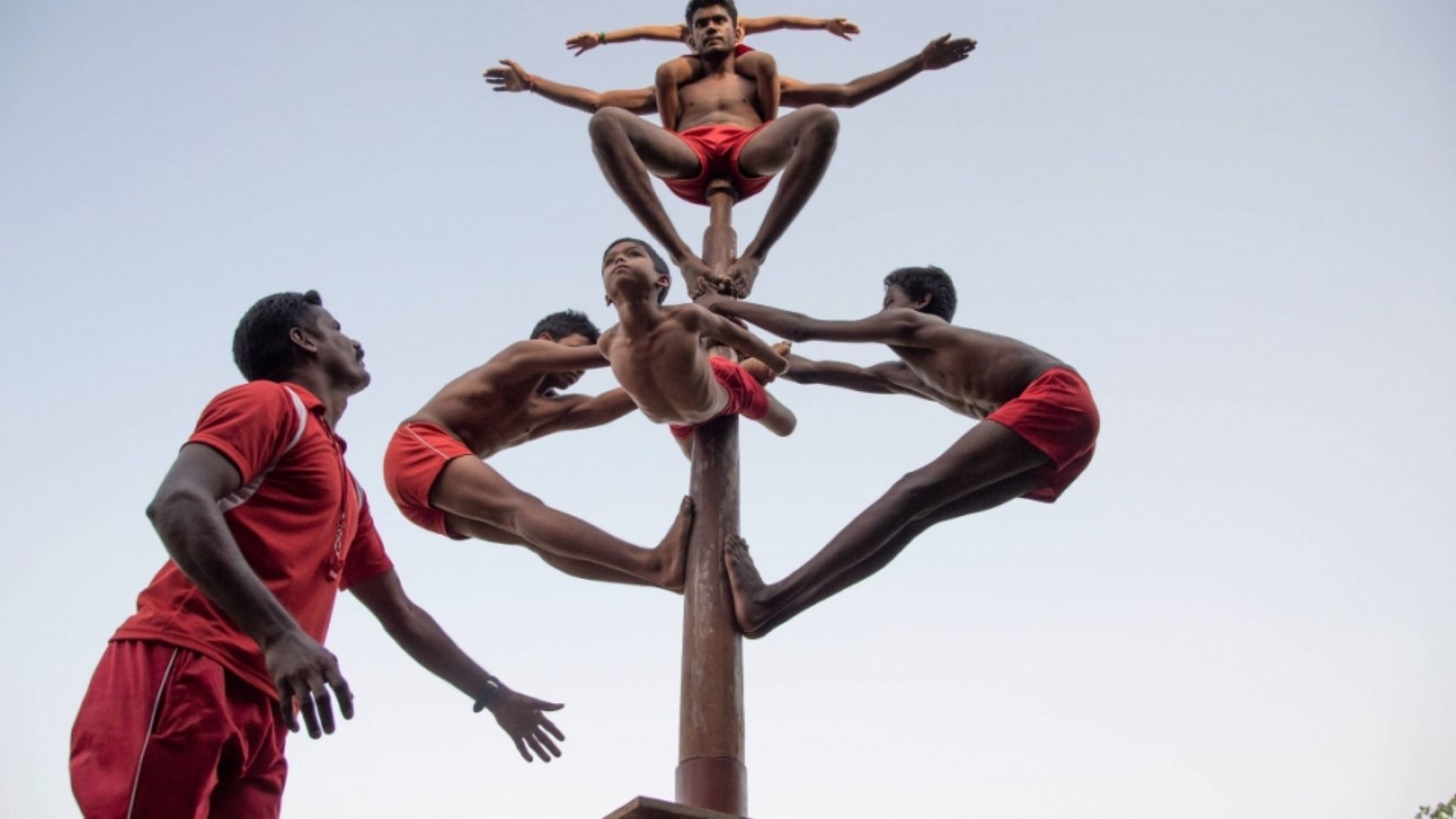
Mallakhamba, a traditional Indian sport blending gymnastics, yoga, and wrestling, involves aerial feats on a vertical pole, rope, or cane, emphasizing strength, balance, and flexibility. Originating in the Indian subcontinent around the 2nd century BCE, it was demonstrated at the 1936 Berlin Olympics and is governed by the Mallakhamb Federation of India (MFI). With three variants—pole, hanging, and rope—mallakhamba is practiced by men, women, and youth in 28 states. In India, mallakhamba thrives, with 50,000+ practitioners, and the 2025 World Mallakhamb Championship in Mumbai targeting 20 nations.
History
Mallakhamba’s roots trace to ancient India, with depictions in 2nd-century BCE Chandraketugarh pottery showing pole acrobatics. The 1135 CE Manasollasa by Someshvara III mentions it, and 7th-century traveler Xuanzang described pole rites at Prayagraj. Rajput and Mughal art (16th-17th centuries) illustrate it, and high-diving variants emerged in 19th-century Europe. Revived in the 1930s, it debuted at the 1936 Olympics as a demonstration. The MFI, founded in 1982, hosted the first National Championships in 1962. Madhya Pradesh declared it the state sport in 2013, followed by 20+ states by 2025.
India’s mallakhamba surged in the 2000s, with the 2024 National Championships in Ujjain drawing 1,500+ athletes, 40% female.
Types and Specifications
Mallakhamba has three variants, each with specific dimensions:
| Variant | Description | Senior Specs | Sub-Junior Specs |
|---|---|---|---|
| Pole Mallakhamba | Acrobatics on a fixed teak/sheesham pole, smeared with castor oil for grip. | 2.6m height, 55cm base, 35cm top circumference. | 2.1m height, similar proportions. |
| Hanging Mallakhamba | Pole suspended by chains, allowing a gap below. | 2.1m height, 45cm base, 35cm top. | 1.8m height, 45cm base, 30cm top. |
| Rope Mallakhamba | Climbs and poses on a suspended rope, historically cane. | 5.5m length, 1-2cm diameter. | 4.5m length, 1-2cm diameter. |
India’s pole variant dominates, with 70% of competitions; 2024 Ujjain nationals featured 80% pole events.
Competition
- World Championships: Since 2019; India won 10/15 golds in 2023.
- National Championships: Annual since 1962; 2024 Ujjain event had 12 categories.
- Asian Championships: Quadrennial; India leads with 15 titles.
- Olympic Recognition: Demonstrated 1936; MFI pushes for 2036 inclusion.
India’s Himani Parab (rope) won gold at the 2019 World Championships, with 2025 Mumbai event expecting 2,000+ participants.
Equipment
- Pole: Teak/sheesham, 2.6m tall, tapered, oiled for grip.
- Rope: Cotton, 5.5m, 1-2cm diameter.
- Cane: Flexible grass, 4-5m for hanging variant.
- Grips: Wrestling holds for aerial yoga-like poses.
India’s MFI provides standardized poles; 2024 trials for affordable local variants.
Cultural Significance
Mallakhamba symbolizes discipline and heritage, influencing pole dancing and aerial arts. It’s performed at festivals and integrated into yoga for flexibility. Media features include Bajirao Mastani (2015) and B (2020).
India’s 2025 Khelo India Youth Games in Haryana will include mallakhamba, expecting 5,000+ youth.
Table of Mallakhamba Milestones and India’s Role
| Milestone | Global Description | India Relevance |
|---|---|---|
| Origins | 2nd century BCE; Manasollasa (1135 CE). | Chandraketugarh pottery depictions; 50,000+ practitioners. |
| Olympic Demo | 1936 Berlin; first national leagues 1962. | MFI formed 1982; 2024 Ujjain nationals 1,500+ athletes. |
| State Sport Status | Madhya Pradesh 2013; 20+ states by 2025. | Haryana, Maharashtra lead; 2025 World Cup in Mumbai. |
| World Championships | Since 2019; India dominates. | 10/15 golds in 2023; Himani Parab’s 2019 rope gold. |
| Cultural Festivals | Hola Mohalla, state games. | 2025 Khelo India Youth Games; 5,000+ youth expected. |
Mallakhamba’s fusion of gymnastics and tradition captivates. India’s MFI, with stars like Himani Parab, eyes 2036 Olympic inclusion. Visit mallakhamb.com or mfi.org.in for more.